Services and Revenue Opportunities in Freight & Transportation
Business research chapter · Primary market: Saudi Arabia, with GCC and international operations
Srudy Objectives
This chapter answers six practical questions:
-
What are the main freight services, and how do they differ operationally?
-
How do FCL, LCL, full-truckload and less-than-truckload shipments work?
-
What do express, standard and economy shipping options mean in practice?
-
What responsibilities are included in door-to-door, port-to-port and port-to-door services?
-
How do cross-border trucking, project cargo, temperature-controlled freight and oversized cargo work?
-
Which services can a new company coordinate through partners, and which require specialised equipment, licences, approvals or experienced personnel?
The goal is to identify commercially viable services, understand their operational complexity, and determine which services are suitable for a new freight business.
1. The four primary modes of transportation
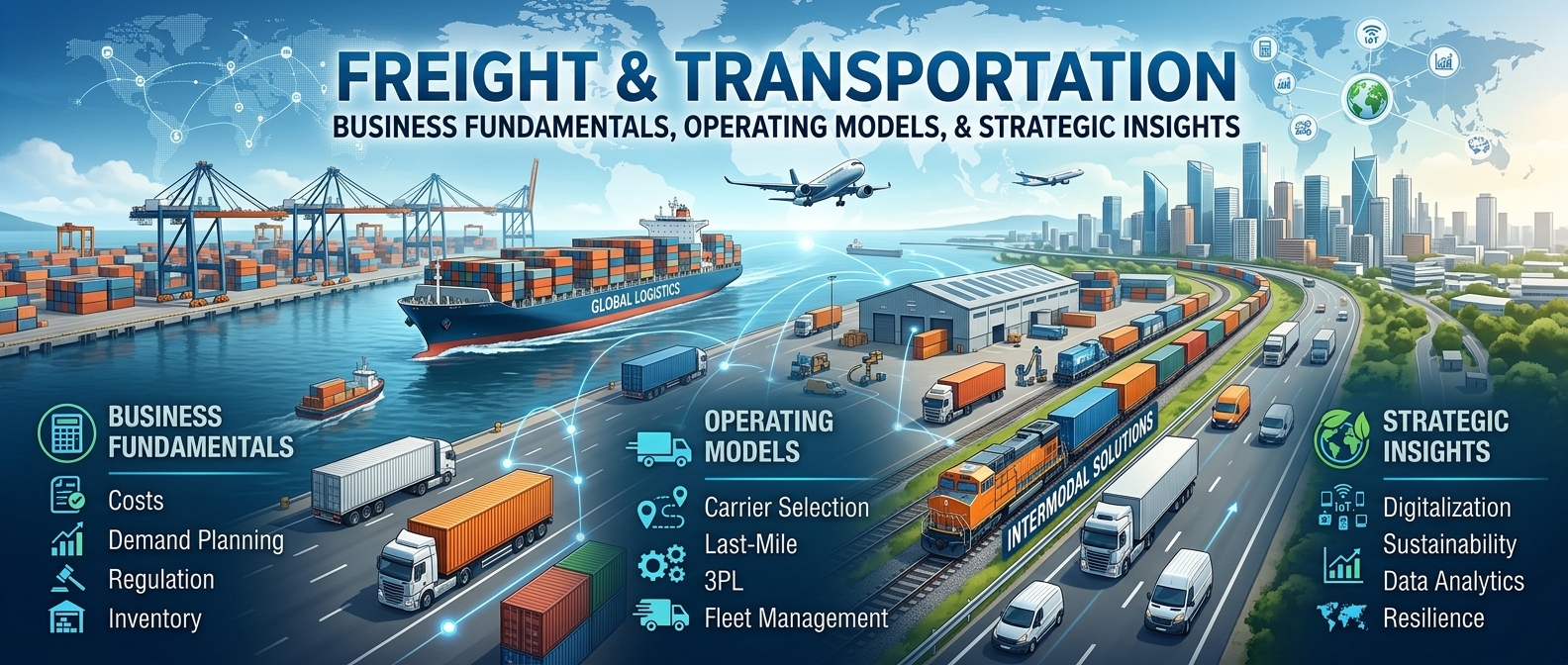
The first decision in a freight business is choosing how the cargo should move. Air, sea, road and rail are not interchangeable products: each has different cost structures, transit characteristics, capacity constraints and operational requirements.
1.1 Air freight

Air freight transports goods by aircraft, either on dedicated freighter aircraft or in cargo capacity available on passenger flights.
It is generally most attractive when speed, shipment value, inventory availability or cargo characteristics justify the cost.
Typical customers
-
Electronics and technology distributors.
-
Manufacturers needing urgent components.
-
Automotive parts suppliers.
-
Medical and pharmaceutical supply chains.
-
Fashion and retail businesses with time-sensitive stock.
-
Businesses shipping samples, documents or high-value products.
How the service works
-
The customer provides the cargo details, origin, destination and required delivery date.
-
The forwarder obtains rates and available capacity from airlines or authorised air cargo partners.
-
The cargo is collected and delivered to the origin handling facility.
-
Packaging, security screening, documentation and any applicable dangerous-goods checks are completed.
-
The shipment is accepted, loaded and transported.
-
At destination, cargo handling, customs clearance and delivery are coordinated.
-
The forwarder obtains delivery confirmation and reconciles the shipment costs.
Air freight rates may be based on chargeable weight, which takes into account both actual gross weight and volumetric weight. The applicable conversion factor and rounding rules must be confirmed with the airline or service provider.
For example, a large but lightweight carton can occupy substantial aircraft capacity and be charged at a higher volumetric weight than its physical weight.
Revenue opportunities
-
Freight margin between the supplier's rate and customer selling price.
-
Pickup and delivery coordination.
-
Documentation and handling fees.
-
Consolidation services.
-
Urgent shipment management.
-
Specialist cargo coordination where the company has qualified partners.
Business advantages
Air freight can support urgent shipments, higher-value goods and customers who need predictable replenishment. A forwarder can offer it without owning an aircraft.
Business disadvantages
Capacity can be constrained, rates can change, and airport handling, security screening, customs or missed connections can delay delivery. Customers may be particularly sensitive to delays because they chose air freight for speed.
Special requirements
Air freight requires competent handling of air cargo documentation and acceptance requirements. Dangerous goods, temperature-sensitive pharmaceuticals, live animals and other restricted cargo may require specialised packaging, trained personnel, specific approvals and carrier acceptance. ICAO's Technical Instructions provide the authoritative international framework for dangerous goods carried by air.
Practical assessment: Air freight can be a good service to offer through established airline and handling partners, provided the business understands chargeable weight, booking cut-offs, security requirements and the limitations of the service it sells.
1.2 Sea freight

Sea freight moves cargo by ocean-going vessels. It is widely used for international trade where shipment volume, weight and total landed cost matter more than the fastest possible transit.
Typical customers
-
Importers and exporters.
-
Manufacturers and industrial suppliers.
-
Furniture and building-material distributors.
-
Retailers importing inventory.
-
Machinery and equipment suppliers.
-
Businesses moving large quantities of non-urgent cargo.
Main service types
-
FCL: Full Container Load.
-
LCL: Less than Container Load.
-
Breakbulk cargo.
-
Roll-on/roll-off (Ro-Ro) cargo.
-
Refrigerated container (reefer) cargo.
-
Out-of-gauge cargo.
-
Port-to-port and integrated door-to-door shipping.
How the service works
The forwarder obtains a rate from a shipping line or ocean freight partner, arranges cargo collection and origin handling, coordinates the shipping documents, monitors the vessel movement and arranges destination handling and any contracted onward transportation.
Sea freight normally involves more planning than a simple domestic truck movement. Booking deadlines, port cut-offs, container availability, vessel schedules, transshipment, customs procedures and destination charges can all affect the final result.
Revenue opportunities
-
Ocean freight margin.
-
FCL and LCL coordination.
-
Origin and destination handling coordination.
-
Documentation and consolidation fees.
-
Container delivery and collection arrangements.
-
Storage and onward transportation coordination where contracted.
Business advantages
Sea freight is suited to larger shipments and can support repeat business from importers and exporters. LCL also gives customers a way to ship smaller volumes without paying for an entire container.
Business disadvantages
Longer transit times, port congestion, vessel schedule changes, storage charges and container detention or demurrage can create substantial cost and customer-service problems.
Special requirements
The company needs reliable shipping-line or freight partners, accurate cargo information, appropriate transport documentation and clear knowledge of which origin and destination charges are included. Breakbulk, dangerous goods, reefer and oversized cargo require additional operational capability.
Practical assessment: Sea freight offers a broad range of commercial opportunities, especially for recurring import/export customers. FCL and standard LCL are generally more straightforward starting points than hazardous, refrigerated or project cargo.
1.3 Road freight

Road freight transports cargo by truck. It is particularly useful for domestic delivery, first- and last-mile transportation, cross-border movements and connecting ports, airports, warehouses and customers.
Typical customers
-
Importers and exporters.
-
Wholesalers and distributors.
-
Manufacturers.
-
Construction contractors.
-
Retail chains.
-
Businesses requiring regular replenishment between warehouses and branches.
Main service types
-
FTL: Full Truckload.
-
LTL: Less-than-Truckload.
-
Container haulage.
-
Domestic distribution.
-
Cross-border trucking.
-
Temperature-controlled transport.
-
Heavy haulage and specialised cargo transport.
How the service works
The provider confirms the pickup and delivery locations, cargo weight and dimensions, vehicle requirements, loading arrangements and delivery schedule. It assigns suitable capacity, dispatches the vehicle, monitors progress and obtains proof of delivery.
For international road freight, the process also requires checking border formalities, vehicle and operator permissions, driver requirements, customs documents and the conditions governing the specific route.
Revenue opportunities
-
Per-trip or per-route transport charges.
-
FTL and LTL coordination.
-
Container haulage.
-
Regular distribution contracts.
-
Pickup and delivery services.
-
Dedicated vehicle arrangements.
-
Cross-border freight coordination.
Business advantages
Road transport provides flexible pickup and delivery and can be used across many customer segments. It is also an important component of sea and air freight services.
Business disadvantages
Fuel-price changes, empty return journeys, traffic, vehicle breakdowns, waiting time, driver availability and border delays can affect profitability.
Special requirements
A company operating trucks needs to verify the applicable vehicle, operator, transport and route requirements. A freight intermediary using subcontractors must separately verify the legal conditions for arranging transportation and the credentials of its partners. Saudi Arabia's Transport General Authority regulates land transport activities and licenses relevant service providers.
Practical assessment: Road freight is a practical service to coordinate through established providers. Domestic routes with repeat customers are often simpler to manage initially than international routes with complex border and customs requirements.
1.4 Rail freight

Rail freight moves goods by train, usually in containers, bulk wagons or specialised rail equipment. It is particularly useful for suitable inland corridors and high-volume cargo movements.
In Saudi Arabia, rail freight is part of the wider national transport system. The Transport General Authority identifies rail transport as a regulated activity and is responsible for the relevant licensing and oversight framework.
Typical customers
-
Industrial manufacturers.
-
Bulk commodity businesses.
-
Large importers and exporters.
-
Businesses moving containerised goods between rail-connected terminals.
-
Customers with recurring high-volume movements.
How the service works
The forwarder checks whether the origin and destination have suitable rail access, confirms available rail services and terminal arrangements, and coordinates the first-mile and final-mile road legs.
Rail is often part of a multimodal shipment rather than a complete door-to-door solution.
Revenue opportunities
-
Rail freight coordination.
-
Container movement arrangements.
-
Rail-road multimodal services.
-
First- and last-mile trucking.
-
Terminal and cargo-handling coordination.
-
Long-term transport contracts for recurring volumes.
Business advantages
Rail can be attractive for suitable high-volume routes and predictable flows of goods. It can also reduce dependence on long-distance road transport on corridors where rail capacity is commercially viable.
Business disadvantages
Rail depends on network access, schedules, terminal capacity and the availability of connecting transport. It may be impractical for locations that are far from suitable terminals or have insufficient volume.
Special requirements
The forwarder needs access to a suitable rail operator or authorised service provider, terminal arrangements, compatible loading units and dependable road connections. Operating railway infrastructure or providing rail transport directly is a different business from arranging a rail shipment through an established operator.
Practical assessment: Rail is worth offering when customer demand and available corridors support it. For a new asset-light forwarder, coordination through established operators is more practical than attempting to operate rail assets.
2. Comparing the four transport modes
|
Factor |
Air |
Sea |
Road |
Rail |
|---|---|---|---|---|
|
Main commercial advantage |
Speed |
Capacity and cost for suitable volumes |
Flexible pickup and delivery |
Efficient movement on suitable corridors |
|
Typical shipment profile |
Urgent, lighter or high-value goods |
Large, heavy or non-urgent cargo |
Domestic, regional and connecting transport |
High-volume or corridor-based movements |
|
Door-to-door potential |
Yes, with ground transport |
Yes, with inland transport |
Yes, subject to route and access |
Usually requires road connections |
|
Typical planning concern |
Chargeable weight and capacity |
Vessel schedules and port charges |
Vehicle availability and route costs |
Network and terminal access |
|
Entry through partners |
Yes |
Yes |
Yes |
Yes, where service is available |
|
Common complexity drivers |
Security and restricted cargo |
Customs, ports and specialised containers |
Borders, vehicle rules and waiting time |
Terminals, schedules and intermodal transfers |
No mode is universally best. The correct option depends on the customer's delivery deadline, cargo dimensions, total cost, handling needs, route availability and risk tolerance.
A freight forwarder should sell the most suitable solution, not automatically push the mode with the highest quoted freight charge.
3. FCL, LCL, FTL and LTL: understanding shipment capacity
These four terms describe how cargo uses container or vehicle capacity. They are important because the wrong choice can make a quotation uncompetitive or create unnecessary transport costs.
3.1 FCL — Full Container Load

FCL means the customer books a container for its shipment. The container is allocated to that shipment rather than shared as an LCL consolidation.
FCL does not necessarily mean the container is physically filled to capacity. A customer can book a container even when the cargo does not occupy all its available space.
Example: An importer ships a large quantity of furniture from an overseas supplier to Saudi Arabia. It books a 40-foot container and arranges collection, ocean transport, customs clearance and delivery.
How the forwarder earns money
The forwarder buys capacity and associated services from its suppliers, then sells an agreed shipment service to the customer. Revenue may also include coordination, handling and documentation fees.
Advantages
-
No need to consolidate unrelated customers' cargo inside the booked container.
-
More control over the shipment's loading and unloading plan.
-
Often commercially attractive when cargo volume is sufficient.
-
Suitable for repeat importers with regular container volumes.
Disadvantages
-
The customer may pay for unused capacity.
-
Container availability and port schedules can affect the shipment.
-
Incorrect loading or delayed return of a container can cause additional costs.
-
Cargo securing, weight distribution and applicable safety rules must be managed properly.
Best customers: Importers, manufacturers, distributors and businesses moving sufficient volume on a recurring basis.
3.2 LCL — Less than Container Load

LCL allows several customers' shipments to share container capacity. A consolidator combines the cargo at origin, transports it in a shared container, and arranges separation and release at destination.
Example: Three businesses each have a small shipment of commercial goods. Instead of booking three containers, their shipments are combined into a shared container, subject to compatibility and handling requirements.
How the forwarder earns money
The forwarder charges the customer according to the applicable pricing basis and service charges, while purchasing consolidation and transport services from its suppliers.
The commercial calculation must include consolidation handling, documentation, origin and destination charges, and any minimum charges that apply.
Advantages
-
Customers do not need enough cargo to justify an entire container.
-
Supports smaller importers and frequent low-volume shipments.
-
Creates opportunities for repeat consolidation services.
-
Allows a forwarder to serve customers that would not otherwise purchase FCL.
Disadvantages
-
More coordination is required because several shipments share the same container.
-
One shipment's documentation or customs problem may complicate the consolidation.
-
Origin and destination handling charges can make small shipments unexpectedly expensive.
-
Consolidation schedules can affect transit time.
Best customers: Small and medium-sized importers, sample shipments, smaller distributors and businesses whose cargo volumes do not justify FCL.
3.3 FTL — Full Truckload

FTL means a truck is booked for a shipment or customer movement on a dedicated basis. The truck does not need to be completely filled physically; the important distinction is that the transport capacity is dedicated rather than shared as in conventional LTL.
Example: A distributor requires a dedicated truck to move palletised goods from a warehouse in Riyadh to a customer in Jeddah.
The transport provider quotes for the vehicle movement, and the forwarder can add pickup coordination, shipment management and delivery services.
Advantages
-
Fewer consolidation and deconsolidation steps.
-
Greater control over pickup and delivery scheduling.
-
Suitable for larger shipments and dedicated movements.
-
Can reduce handling when cargo moves directly between locations.
Disadvantages
-
The customer may pay for unused vehicle capacity.
-
Empty return journeys and vehicle positioning can increase costs.
-
Waiting time, access restrictions and unloading delays can affect the economics.
Best customers: Wholesalers, manufacturers, distributors and customers with regular large road shipments.
3.4 LTL — Less-than-Truckload

LTL combines shipments from different customers into shared road transport capacity. Cargo may pass through terminals or consolidation facilities before reaching its destination.
Example: Several businesses each have a few pallets to deliver along compatible routes. A transport provider combines their freight instead of assigning a separate truck to each customer.
Advantages
-
Suitable for customers with smaller loads.
-
Makes shared vehicle capacity commercially useful.
-
Can support frequent shipments without dedicated trucks.
-
Allows a forwarder to offer domestic distribution to smaller customers.
Disadvantages
-
Additional terminal handling may increase damage risk.
-
Delivery times can be less predictable than a dedicated movement.
-
Pricing can include minimum charges, handling fees, weight or volume calculations, and accessorial charges.
-
The provider must manage compatibility, routing and consolidation cut-offs.
Best customers: Small and medium-sized businesses, distributors, retail suppliers and customers shipping less than a full truckload.
3.5 FCL versus LCL and FTL versus LTL
|
Shipment type |
Capacity arrangement |
Best suited to |
|---|---|---|
|
FCL |
Dedicated shipping container |
Cargo volume that justifies booking a container |
|
LCL |
Shared shipping container |
Smaller international sea shipments |
|
FTL |
Dedicated truck movement |
Large or time-sensitive road loads |
|
LTL |
Shared road transport capacity |
Smaller domestic or regional road shipments |
FCL/LCL usually refer to containerised freight, especially sea freight. FTL/LTL refer to road freight. The concepts are similar, but the pricing, handling and documentation processes are different.
3.6 How should a forwarder decide which option to offer?
The decision should be based on the total shipment cost and operational requirements, not simply the cargo's weight.
For sea freight, compare the complete cost of FCL with the full LCL charges, including origin handling, consolidation, destination handling and delivery.
For road freight, compare the dedicated truck price with the LTL rate, including terminal handling, estimated transit time, delivery requirements and cargo-handling risks.
The forwarder should also check the cargo's dimensions, stackability, weight distribution, packaging, value, fragility and any restrictions on sharing capacity.
Business lesson: LCL and LTL allow a company to serve smaller customers, while FCL and FTL can be commercially attractive for larger and recurring shipments. Offering all four through partners can broaden the customer base without requiring the forwarder to own containers or trucks.
4. Express, standard and economy shipping
These terms describe service levels rather than a single transport mode. An express shipment might use air freight, an expedited road service or a courier network. Standard and economy services can also use different transport combinations.
The precise definition varies by provider. Never promise a universal delivery time based only on the label.
Express shipping
Express prioritises speed and handling through the provider's available service network. It may use priority capacity, more direct routing, tighter handling windows or dedicated delivery arrangements.
Typical customers include businesses with production stoppages, urgent spare parts, time-sensitive documents or high-value goods where delay is costly.
The price may be substantially higher than standard service, and express still cannot eliminate every possible customs, security, weather or capacity delay.
Standard shipping
Standard shipping balances cost, transit time and service reliability. It is often appropriate for routine commercial cargo when the customer has a known delivery window and does not require premium urgency.
A forwarder can make this a core service for repeat customers by selecting reliable suppliers, establishing booking routines and monitoring performance.
Economy shipping
Economy shipping prioritises lower transport cost, often through less urgent capacity, consolidation or longer routing. It is suitable when delivery timing is flexible.
The customer should understand the expected transit range, cut-off dates, handling arrangements and what happens if a connecting service is missed.
Comparison
|
Factor |
Express |
Standard |
Economy |
|---|---|---|---|
|
Priority |
Speed |
Balanced service |
Lower cost |
|
Price |
Usually highest |
Intermediate, depending on route |
Often lowest |
|
Capacity |
Priority or expedited capacity where offered |
Regular scheduled capacity |
More flexible or less urgent capacity |
|
Consolidation |
Depends on the service |
Common in some services |
Common in many economy offerings |
|
Best fit |
Urgent shipments |
Routine commercial shipments |
Flexible delivery schedules |
|
Main risk |
Premium price without guaranteed end-to-end control |
Transit variation |
Longer or less predictable delivery |
These are general commercial patterns, not fixed rate or delivery guarantees.
How a freight company should sell service levels
A forwarder should quote comparable options side by side and explain the trade-off clearly.
For example, the quotation can show:
-
The service provider and transport mode.
-
Estimated transit time and what the estimate covers.
-
Booking and cargo cut-off requirements.
-
Whether pickup, customs coordination and final delivery are included.
-
Applicable surcharges and exclusions.
-
The conditions under which the transit estimate may change.
This creates an opportunity to earn revenue by helping customers choose the appropriate service, rather than simply offering the cheapest available rate.
Important distinction: An estimated transit time is not necessarily a guaranteed delivery commitment. If a forwarder sells a guaranteed service, it must understand the actual contractual guarantee and its exceptions.
5. Door-to-door, port-to-port and port-to-door services
These terms describe the scope of transportation between the shipment's starting point and destination. They help define what the customer is buying and which tasks the forwarder must coordinate.
Door-to-door

Supplier premises → collection → main transport → applicable clearance coordination → final delivery.
The provider coordinates the full agreed transport journey. Customs clearance, duties, taxes, insurance and special handling are not automatically included; the contract must define them.
Port-to-port

Origin port or terminal → main carriage → destination port or terminal.
The service primarily covers the port-to-port transport segment. Pickup, inland delivery, customs clearance and some terminal charges may be outside the quoted scope.
Port-to-door

Origin port → main carriage → destination port → agreed inland delivery point.
This is useful when the customer arranges origin pickup but wants the forwarder to coordinate onward transportation from the destination port.
Why the scope matters commercially
A customer comparing two quotations may think one is cheaper, when in fact the quotations cover different services.
For example, one quote might include the ocean freight only, while another includes origin handling, destination handling and delivery. Without a clear breakdown, the customer may select a quote that ultimately costs more.
A properly scoped quotation should identify:
-
The exact origin and destination points.
-
The transport legs included.
-
The handling and documentation services included.
-
Who arranges customs clearance and who pays duties and taxes.
-
Which charges are included, excluded or subject to actual costs.
-
Who is responsible for pickup, loading, unloading and delivery confirmation.
-
The agreed contractual responsibility and insurance arrangements.
Incoterms are not the same as transport service scope
Incoterms rules allocate specified responsibilities, costs and risks between sellers and buyers in a sales contract. They do not, by themselves, define every service a freight forwarder provides or replace the transport contract.
For instance, the commercial term agreed between a buyer and seller may affect who arranges main carriage, but the forwarder's actual obligations still depend on its separate agreement and applicable law.
Business lesson: A forwarder can earn more by providing a clearly defined end-to-end service, but the wider the service scope, the greater the need for supplier coordination, accurate pricing and liability management.
6. Specialised freight services and their business opportunities
Specialised cargo can create higher-value opportunities, but it also increases the consequences of operational mistakes. The business should evaluate each service based on demand, available partners, equipment, legal requirements and the cost of failure.
6.1 Cross-border trucking

Cross-border trucking moves goods between countries by road. For a Saudi-based freight business, this can include suitable GCC routes and other permitted international corridors.
How the service works
-
Confirm the origin, destination, cargo details and delivery deadline.
-
Verify that the carrier and vehicle are authorised for the relevant route.
-
Establish which party handles export and import declarations.
-
Confirm border documents, permits, insurance and any transit requirements.
-
Book the vehicle and arrange collection.
-
Monitor border clearance, transit and delivery.
-
Reconcile waiting time, border charges and other agreed costs.
Revenue opportunities
-
Per-trip transport margin.
-
Recurring cross-border transport contracts.
-
Border-to-warehouse delivery coordination.
-
FTL and LTL services where supported.
-
Consolidation and onward distribution.
Main commercial risks
Border delays, incomplete documents, vehicle authorisation issues, changes in fuel or route costs, waiting-time charges and missed delivery slots.
What is required?
A new entrant can potentially coordinate the service through appropriately authorised carriers. It must still verify the licensing conditions for its own intermediary activity, the carrier's authority, route-specific permissions, customs responsibilities and the documentation applicable to each country.
Practical assessment: A promising service when customers have repeat flows across a particular corridor. Start with one route and reliable partners rather than offering every international destination immediately.
6.2 Project cargo

Project cargo involves planning and moving cargo associated with large industrial, construction, energy or infrastructure projects. Shipments may involve heavy machinery, large components, multiple transport modes and coordinated delivery schedules.
Unlike routine freight, project cargo often requires engineering input and advance planning before the cargo is ready to move.
Typical customers
-
Construction and engineering contractors.
-
Energy and industrial companies.
-
Infrastructure project owners.
-
Manufacturers of heavy machinery.
-
Companies transporting plant equipment.
How the service works
-
Obtain technical cargo drawings, dimensions, weight and centre-of-gravity information where relevant.
-
Identify loading, lifting, transport and unloading requirements.
-
Assess route restrictions, bridge capacity, road geometry, access and terminal capabilities.
-
Select suitable vessels, trucks, lifting equipment or other transport resources.
-
Obtain required permits and specialist engineering approvals.
-
Coordinate lifting, securing, transit, site access and delivery windows.
-
Manage contingency arrangements and confirm final placement or delivery.
Revenue opportunities
Project planning fees, freight coordination, specialist equipment arrangements, survey coordination, route planning and contracted project-logistics management.
Main risks
Damage to expensive equipment, route restrictions, lifting incidents, missed project milestones, inadequate insurance and contractual penalties.
What is required?
Experienced project-logistics personnel and reliable heavy-haul, lifting, engineering and transport partners. The company must verify the relevant road, port, lifting and cargo-handling permissions for the particular movement.
Practical assessment: Better as a later-stage service or a partnership-led offering until the business has gained experience in routine freight operations and can access qualified specialists.
6.3 Temperature-controlled freight

Temperature-controlled freight moves cargo within a specified temperature range. It can involve refrigerated trucks, reefer containers, insulated packaging, temperature-controlled air cargo and specialised storage facilities.
Typical customers
-
Food producers and distributors.
-
Pharmaceutical and healthcare supply chains.
-
Certain chemical manufacturers.
-
Businesses shipping flowers and other temperature-sensitive products.
-
Importers requiring cold-chain integrity.
How the service works
-
Obtain the product's permitted temperature range and handling instructions.
-
Confirm whether the shipment requires chilled, frozen, controlled-room-temperature or another specified environment.
-
Verify equipment capability and temperature-control procedures.
-
Pre-cool equipment where required and confirm that the cargo is ready for loading.
-
Monitor temperature and other required conditions during transport.
-
Coordinate transfers without compromising the agreed temperature conditions.
-
Retain temperature records and document any excursion or incident.
Revenue opportunities
Reefer freight coordination, temperature-controlled road transport, specialised packaging, monitoring services and recurring cold-chain contracts.
Main risks
Equipment failure, incorrect temperature settings, delays during transfer, insufficient monitoring, power interruption and product spoilage.
What is required?
Appropriate equipment, validated handling procedures where necessary, trained personnel and reliable specialist partners. Pharmaceutical, food and other regulated cargo may have additional product-specific requirements. These must be verified for the commodity, route and relevant authority.
Practical assessment: Potentially valuable where demand is recurring, but not an appropriate service to offer casually. The company must be able to demonstrate how the required conditions will be maintained and how deviations will be handled.
6.4 Oversized and out-of-gauge cargo

Oversized cargo exceeds the applicable dimensional or handling limits of standard transport equipment. Out-of-gauge (OOG) is commonly used for cargo that exceeds the normal dimensions of a container or other standard loading unit.
Not all heavy cargo is oversized, and not all oversized cargo is exceptionally heavy. Dimensions, weight, loading points and route constraints must be evaluated separately.
Typical customers
-
Construction companies.
-
Industrial equipment suppliers.
-
Energy projects.
-
Machinery manufacturers.
-
Businesses importing large components.
How the service works
The forwarder collects the cargo's exact dimensions and weight, checks equipment availability, coordinates technical loading requirements and verifies whether the route requires permits, escorts or specialist handling.
Depending on the cargo, the shipment may use a flat rack, open-top container, low-bed trailer, heavy-haul vehicle, breakbulk vessel or other suitable equipment.
Revenue opportunities
Special equipment coordination, specialist transport arrangements, handling and lifting coordination, permit coordination and project-specific planning fees.
Main risks
Incorrect dimensions, inadequate securing, route restrictions, unsuitable equipment, damage during lifting and costly changes after booking.
What is required?
Accurate technical information, suitable equipment, experienced operators and route-specific regulatory verification. The forwarder should not accept a movement based only on a general description such as “heavy machinery.”
Practical assessment: Offer initially through established specialists. Directly managing complex oversized cargo should follow demonstrated technical competence and appropriate insurance and contractual arrangements.
6.5 How the four specialised services compare
|
Service |
Main source of complexity |
Partner or equipment dependency |
Entry recommendation |
|---|---|---|---|
|
Cross-border trucking |
Borders, documents, permits and route costs |
Authorised international carriers and customs partners |
Consider after establishing reliable route partners |
|
Project cargo |
Engineering, coordination and high consequences of failure |
Heavy-haul, lifting, survey and specialist shipping providers |
Partner-led initially |
|
Temperature-controlled freight |
Maintaining the required conditions throughout transit |
Refrigerated vehicles, reefer containers, monitoring and qualified handlers |
Enter only with verified capability |
|
Oversized/OOG cargo |
Dimensions, weight, route feasibility and handling |
Specialised equipment, engineering and permits |
Partner-led until sufficient experience is gained |
The distinction is not simply between profitable and unprofitable services. It is between services the business can reliably deliver with its current capabilities and services that require capabilities it has not yet developed.
7. Which services require specialised equipment, approvals, partners or experience?
A freight company should assess each service across four separate dimensions. These are not interchangeable: having a capable supplier does not automatically satisfy the company's own licensing requirements.
-
Equipment: Is specialised physical capacity necessary?
-
Approval: Does the activity, cargo, route or facility require specific authorisation?
-
Partner: Does the business need an external carrier, broker, handler or technical specialist?
-
Experience: Does the shipment require technical knowledge beyond routine forwarding?
Service requirements matrix
|
Service |
Equipment needs |
Specialist partners or expertise |
Regulatory verification |
|---|---|---|---|
|
Standard air freight |
Airline and airport cargo capacity |
Airline, cargo handler, ground transporter |
Air cargo and intermediary activity requirements |
|
Dangerous goods by air |
Approved packaging and handling arrangements as applicable |
Competent dangerous-goods personnel and accepting carrier |
Applicable ICAO requirements, airline rules and commodity restrictions |
|
Standard sea freight |
Container and vessel capacity |
Shipping line, consolidator and port handlers |
Forwarding, port and customs requirements |
|
Reefer sea freight |
Refrigerated container and appropriate power/monitoring arrangements |
Reefer-capable carrier and qualified handlers |
Commodity-specific requirements |
|
Standard domestic road freight |
Suitable truck or subcontracted vehicle |
Authorised road carrier |
Saudi transport activity and vehicle requirements |
|
Cross-border trucking |
Suitable vehicle and route capacity |
International carrier and customs partners |
Route-specific permits, customs and border requirements |
|
Rail freight |
Rail capacity and terminal access |
Rail operator and connecting road carriers |
Applicable rail activity and access requirements |
|
FCL/LCL |
Container or consolidation capacity |
Shipping line, consolidator and destination agent |
Applicable forwarding and customs requirements |
|
FTL/LTL |
Dedicated or shared road capacity |
Road carrier or consolidation network |
Applicable road transport requirements |
|
Project cargo |
May require lifting gear, heavy-haul vehicles or specialised loading equipment |
Engineers, surveyors and specialist carriers |
Route, lifting, transport and cargo-specific permissions |
|
Temperature-controlled cargo |
Refrigerated vehicle, reefer container or other suitable system |
Cold-chain specialist and qualified handling providers |
Product-specific requirements and any applicable approvals |
|
Oversized/OOG cargo |
Special container, trailer, lifting or securing equipment as required |
Heavy-haul specialist, engineering and route-planning support |
Oversize permits and route restrictions where applicable |
The matrix is a planning guide, not a complete legal clearance. Actual requirements depend on the shipment, route, commodity and precise role of the company.
Saudi Arabia: what must be checked before offering a service
The Transport General Authority regulates land, sea and rail transport activities within its remit and provides licensing services for relevant activities. Its official services include land and maritime transport licensing, while separate air cargo and air freight agent licensing services are also listed on the Saudi government portal.
Customs clearance is a separate issue. ZATCA provides a customs-broker authorisation service through which importers and exporters can authorise a broker to handle specified customs dealings. ZATCA also has a freight-forwarder registration process with stated licence and commercial-registration prerequisites.
For each intended service, the business should establish:
-
Which commercial activity it will perform.
-
Which authority regulates that activity.
-
Whether a separate licence, registration or permit is required.
-
Whether it can subcontract the physical work and what obligations remain with it.
-
Whether the cargo needs product-specific documentation, permits or technical handling.
-
Which contractual and insurance arrangements are needed.
This verification should happen before the service is marketed as available.
8. Which services should a new freight company offer first?
The right starting point is not to offer every service. It is to choose a manageable combination that meets real customer demand and can be delivered reliably.
The following ranking is a strategic assessment for a new asset-light business. It is not a measured market-demand ranking, and the actual order should be adjusted once customer enquiries, partner rates and route availability are known.
|
Service |
Operational complexity |
Capital requirement for an asset-light company |
Suggested priority |
|---|---|---|---|
|
Standard sea freight — FCL |
Moderate |
Low to moderate |
High |
|
Standard air freight |
Moderate |
Low to moderate |
High |
|
Domestic FTL coordination |
Low to moderate |
Low |
High |
|
Standard LCL |
Moderate |
Low to moderate |
High after reliable consolidation arrangements |
|
Domestic LTL |
Moderate |
Low to moderate |
Consider where partner networks exist |
|
Port-to-door coordination |
Moderate |
Low to moderate |
High when reliable local carriers are available |
|
Rail freight |
Route-dependent |
Low to moderate |
Conditional on viable rail corridors |
|
Cross-border trucking |
Moderate to high |
Low to moderate |
Build after route-specific verification |
|
Temperature-controlled freight |
High |
Low to high, depending on the operating model |
Specialist partner-led |
|
Oversized/OOG cargo |
High |
Low to high, depending on scope |
Specialist partner-led |
|
Project cargo |
Very high |
Variable |
Later-stage or specialist partnership |
“Low capital” here means the company can potentially arrange the service without owning the main transport assets. It does not mean the business needs no working capital, insurance, licences, systems or cash reserves.
Our recommended initial service portfolio
For a new entrant that has completed the required Saudi legal setup, We would start by investigating four offerings:

1. Standard sea freight — FCL
Target businesses with recurring container shipments. Build reliable shipping-line and destination-agent relationships, and learn the full cost structure.

2. Standard air freight
Target customers who value speed and dependable shipment coordination. Establish a reliable airline or air cargo partner and a clear chargeable-weight process.

3. Domestic FTL coordination
Focus on defined routes and repeat business customers. Verify carriers, waiting-time terms, delivery confirmation and payment arrangements.

4. Port-to-door coordination
Combine international freight with local delivery through vetted providers. Make the included services, exclusions and additional charges explicit.
This is a starting hypothesis, not a final investment decision. LCL, LTL and specialised freight should be added when there is a suitable supplier network and demonstrable customer demand.
9. Revenue opportunities across the service portfolio
A forwarder can generate revenue in several ways. The best model depends on the customer's requirements, supplier contracts, the company's legal role and the services actually performed.
|
Revenue stream |
How it works |
Main control required |
|---|---|---|
|
Freight margin |
Customer price exceeds the relevant supplier cost |
Accurate buy rates and complete cost allocation |
|
Explicit coordination fee |
Customer pays for managing the shipment |
Clear scope and documented service value |
|
Documentation or handling fee |
Charge for agreed documentation or handling work |
Avoid double charging and clarify exclusions |
|
Consolidation revenue |
Revenue from organising shared shipment capacity |
Accurate volume calculations and handling costs |
|
Pickup and delivery coordination |
Margin or fee on contracted inland transport |
Carrier verification and route cost control |
|
Contracted logistics services |
Recurring fee for an agreed package or volume |
Service levels, capacity planning and contract management |
|
Specialist coordination |
Fee for managing complex or regulated shipments |
Competent partners, approvals and clear liability boundaries |
These revenue streams are not automatically additive. A quotation must make clear which charges are included in the freight price and which are separately billed.
A worked example
Suppose a forwarder quotes a customer SAR 12,000 for a shipment. Its actual supplier and direct shipment costs total SAR 10,800.
-
Customer revenue: SAR 12,000.
-
Supplier and direct costs: SAR 10,800.
-
Shipment contribution: SAR 1,200.
-
Contribution margin: 10%.
If a second shipment generates the same revenue but incurs an unexpected SAR 900 charge that the forwarder cannot recover from the customer, its contribution falls to SAR 300.
This illustrates why a freight business needs reliable cost estimates, well-defined quotation terms and a process for approving additional costs. The figures are illustrative, not current market rates.
10. Practical decision framework before accepting a shipment
Before quoting or accepting a shipment, the company should answer these questions:
Shipment acceptance checklist
0/10
Final findings
The key business lessons from this chapter are:
-
Air, sea, road and rail serve different customer needs. A forwarder should choose based on the full shipment economics and service requirements.
-
FCL, LCL, FTL and LTL create different ways to sell transport capacity, allowing a company to serve both large and small customers.
-
Express, standard and economy are service-level choices whose precise commitments must be verified with the provider.
-
Door-to-door, port-to-port and port-to-door describe different service scopes. Clear scope prevents disputes and unplanned costs.
-
Cross-border, project, temperature-controlled and oversized cargo can create specialist opportunities, but they require more verification, experience and partner capability.
-
An asset-light company can offer many transport services without owning vehicles, containers or aircraft, but it must still satisfy the licensing and contractual requirements that apply to its own activities.
-
The strongest initial portfolio is one the company can price accurately, coordinate consistently and deliver with dependable partners.
The next stage of this research should be 03 — End-to-end operational process: how to receive a freight enquiry, collect shipment details, calculate chargeable weight and volume, obtain supplier quotations, build a profitable customer quote, book transport, manage documentation and track the shipment through to delivery and payment.
That stage will turn the service knowledge developed here into a repeatable operating procedure.