End-to-End Operational Process in Freight & Transportation
Research date: 21 October 2026 · Primary market: Saudi Arabia · Scope: international freight and GCC transportation
The objective of this phase is to turn the service knowledge from Phase 02 into a repeatable operating procedure: how to receive an enquiry, obtain accurate shipment information, select a route, calculate a profitable quote, book transport, control documents, monitor the shipment, arrange delivery and collect payment.
The core operating principle is to verify the shipment before committing to a price or delivery promise. Freight costs and timing can change when dimensions are inaccurate, cargo requires special approvals, customs documents are incomplete, or a quoted service excludes destination charges.
One Saudi-specific control needs particular attention. ZATCA's import instructions specify customs documents and declaration procedures before arrival, and its guidance has used both 48-hour and 72-hour pre-arrival references. A prudent internal procedure is to target document readiness at least 72 hours before arrival, then have the appointed customs broker confirm the applicable current deadline for the port, mode and shipment. For sea cargo, ZATCA announced mandatory advance submission of manifests and customs declarations effective 29 October 2025.

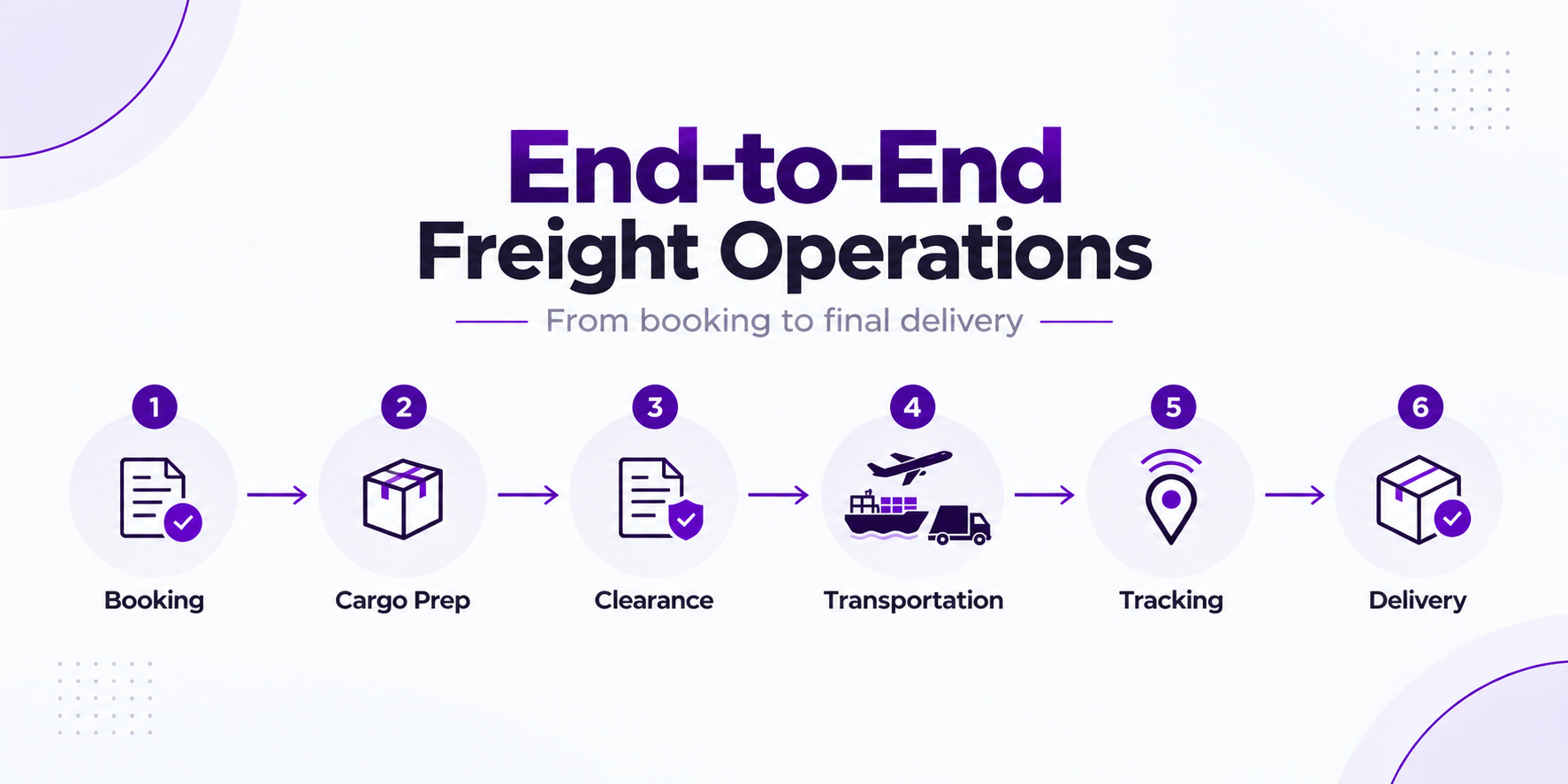
1. The complete shipment workflow
A freight forwarder coordinates multiple parties. The job is not finished when the carrier collects the cargo; the shipment must be documented, tracked, delivered and financially closed.
|
Stage |
Main action |
Required outcome |
|---|---|---|
|
1. Enquiry |
Receive shipment requirements |
Complete enquiry record |
|
2. Screening |
Check cargo, route and restrictions |
Accept, decline or refer for specialist review |
|
3. Routing |
Compare modes, services and transit times |
Feasible transport plan |
|
4. Costing |
Obtain written supplier rates |
Verified cost sheet |
|
5. Quotation |
Price the service and explain conditions |
Written customer quotation |
|
6. Booking |
Obtain customer approval and book partners |
Confirmed booking |
|
7. Preparation |
Collect and verify documents |
Shipment ready for dispatch |
|
8. Collection and dispatch |
Coordinate pickup, handling and export procedures |
Proof of collection and dispatch |
|
9. Main transit |
Monitor milestones and exceptions |
Status records and customer updates |
|
10. Destination handling |
Arrange customs clearance and local charges |
Cargo released for delivery |
|
11. Delivery |
Arrange final transport and confirm receipt |
Proof of delivery |
|
12. Financial close |
Invoice, collect payment and reconcile supplier bills |
Final shipment profitability |
For a new company, each stage should have an assigned person or partner, even when one employee handles several roles. A shipment should never depend solely on an employee's memory or informal messages.
2. Step one: Receive a complete freight enquiry
The first operational risk is quoting from insufficient information. “Ship 500 kg from China to Saudi Arabia” is not enough to calculate a dependable price.
The enquiry form
Collect the following information before requesting supplier rates.
|
Information |
What to collect |
|---|---|
|
Customer |
Legal or trading name, contact person and contact details |
|
Route |
Exact pickup location, origin country, destination country and delivery address |
|
Commodity |
Accurate goods description, intended use and relevant product specifications |
|
Quantity |
Package count, pallet count or container count |
|
Dimensions |
Length, width and height of every package or consistent package type |
|
Weight |
Gross weight; net weight where relevant |
|
Cargo readiness |
Date cargo will be available for collection |
|
Service |
Air, sea, road, rail, FCL, LCL, FTL, LTL, express or another suitable service |
|
Delivery scope |
Port-to-port, door-to-door or another agreed arrangement |
|
Trade terms |
Incoterm and exact named place, where relevant |
|
Customs |
Importer/exporter details, intended customs broker and permit status |
|
Special handling |
Fragile, hazardous, temperature-controlled, high-value, oversized or unusual cargo |
|
Commercial terms |
Required arrival date, budget, payment expectations and insurance request |
Request photographs of the goods and packaging when this would help identify the cargo or estimate handling needs.
Ask these questions before routing
-
What exactly is being shipped, and is it new, used, hazardous or regulated?
-
Is the cargo already packed and ready?
-
Are the weights and dimensions measured, or merely estimated?
-
Who pays for pickup, main carriage, customs, destination handling and final delivery?
-
Does the shipment require an import permit, product registration, special packaging or specific documentation?
-
Is the delivery date a preference or a firm business deadline?
The answers determine which service can be offered, whether a supplier can accept the cargo, and whether the quoted price can be treated as firm.
3. Step two: Screen the shipment before costing
Before asking a carrier to price the job, conduct a basic feasibility review.
Shipment acceptance screen
0 of 8 checks complete
ResetThis is an internal screening aid, not a legal compliance certificate.
Cargo that requires specialist review
Do not confirm acceptance or promise a delivery date until the appropriate provider verifies requirements for dangerous goods, batteries, chemicals, pharmaceuticals, perishables, live animals, high-value cargo, project cargo or oversized shipments.
For air freight, dangerous-goods classification, packaging, labelling and declaration must be handled in accordance with applicable aviation rules. IATA's shipper's declaration guidance explains that consignors must certify the goods have been packed, labelled and declared in accordance with the Dangerous Goods Regulations.
A sensible rule is: if the commodity is uncertain, stop the quotation process and obtain specialist confirmation first.
4. Step three: Choose the appropriate transport plan
The cheapest mode is not necessarily the most economical solution once handling, lead time, inventory costs and delivery risk are considered.
|
Situation |
Route or service to evaluate |
Main decision |
|---|---|---|
|
Small, urgent, high-value goods |
Air freight or express |
Speed versus chargeable weight |
|
Large shipment with flexible timing |
Sea freight |
FCL versus LCL and total landed transport cost |
|
Regular regional cargo |
Road freight |
Border processing, truck type and schedule |
|
Small shipments from multiple suppliers |
LCL or consolidated road freight |
Consolidation cost and added handling time |
|
Full load from one shipper |
FTL or FCL |
Capacity, loading and delivery arrangement |
|
Heavy or oversized machinery |
Specialist road, sea or multimodal solution |
Route surveys, loading equipment, permits and lifting plans |
|
Temperature-sensitive goods |
Qualified temperature-controlled service |
Required temperature range, monitoring and contingency arrangements |
The quotation should clearly distinguish the estimated transit time from the total door-to-door time. Collection, consolidation, customs procedures, port handling and final delivery may add time before or after the main transport leg.
5. Step four: Calculate shipment weight and volume
Accurate dimensions are critical because suppliers may charge by actual weight, volumetric weight, container capacity, vehicle capacity or another contracted basis.
Air freight: chargeable weight
Air cargo commonly compares gross weight with volumetric weight and prices on the applicable chargeable weight. The divisor and rounding rules must be confirmed against the carrier's tariff.
An illustrative calculation using a divisor of 6,000 cubic centimetres per kilogram:
Suppose one carton measures 120 × 80 × 100 cm and weighs 130 kg gross.
The illustrative chargeable weight would be 160 kg because volumetric weight exceeds gross weight. If the supplier uses a different divisor or rounding rule, the charged amount may differ.
For multiple cartons, calculate the total using the supplier's prescribed method. Do not assume the quote is based on gross weight alone.
Sea freight: volume and container planning
For LCL, the consolidator's rate basis may use cubic metres, weight or a tariff-specific weight/measurement rule. Obtain the exact calculation basis, minimum billing unit and any minimum charge.
For FCL, confirm container type, available capacity, payload restrictions, loading location, cargo weight, handling needs and whether the cargo fits within the practical loading dimensions. Container choice is not based on volume alone.
For packed containers, the International Maritime Organization explains that the verified gross mass must be available before the container can be loaded under the relevant SOLAS requirements. The shipper has responsibility for obtaining and communicating that verified mass.
Road freight: load planning
For FTL, determine whether the goods fit safely within the truck's available dimensions and payload. For LTL, check the carrier's chargeable basis, pallet footprint, loading method, stackability and any restrictions on mixed cargo.
The important lesson is that dimensions, weight, commodity and handling requirements should be recorded consistently in the customer quote, booking request and transport documents.
6. Step five: Obtain supplier quotations and build a cost sheet
Ask carriers, agents, trucking partners and handling providers for written quotes using the same shipment information. Comparing prices without matching scope leads to inaccurate decisions.
What to verify in a supplier quotation
Check the route, service, equipment, transit estimate, rate validity, cargo acceptance, included charges, excluded charges, free-time conditions, surcharges and payment terms.
For an international sea shipment, for example, a low ocean-freight rate may exclude origin handling, documentation, destination terminal charges, customs clearance, storage or final delivery. Compare the total expected cost for the complete service, not only the headline freight rate.
Illustrative shipment cost sheet
Assume a hypothetical shipment with these expected costs, all in Saudi riyals:
|
Cost component |
Estimated cost |
|---|---|
|
Main transport |
SAR 6,000 |
|
Origin handling and pickup |
SAR 1,300 |
|
Destination handling |
SAR 1,600 |
|
Final delivery coordination |
SAR 1,100 |
|
Documentation and operational fees |
SAR 300 |
|
Contingency for uncertain operating costs |
SAR 500 |
|
Total expected cost |
SAR 10,800 |
These figures are illustrative, not market-rate estimates. Actual costs must come from current written supplier quotes.
Calculate a sustainable selling price
If total expected cost is SAR 10,800 and the target gross margin is 10%, the required selling price is:
The expected contribution is SAR 1,200, equal to 10% of the selling price before general overheads, financing costs, tax and any other items not included in the cost sheet.
Do not confuse margin with markup. A cost of SAR 10,800 plus a 10% markup gives SAR 11,880, which produces a margin of about 9.1%, not 10%.
Also keep the following separate from the freight margin unless the commercial arrangement explicitly includes them: customs duties, import VAT, government fees and other amounts collected on behalf of third parties. These amounts should be estimated or confirmed by the appropriate party, not casually absorbed into a freight quote.
7. Step six: Send a quotation with clear conditions
A commercial quotation should make it easy for the customer to see what they are buying and where their responsibilities begin.
Freight quotation — recommended structure
Use this as the structure for a reusable quotation form or spreadsheet.
Customer and shipment
Customer name, quotation reference, issue date, origin, destination, commodity, package count, dimensions, gross weight and applicable chargeable weight or volume.
Service and schedule
Transport mode, service level, included pickup or delivery scope, estimated transit time, planned collection date and any important operational assumptions.
Price
Freight charges, origin services, destination services, documentation or handling charges, currency and total quoted amount.
Exclusions and additional costs
Customs duties, import taxes, inspections, storage, demurrage, detention, waiting time, special handling, insurance and other charges not explicitly included.
Terms
Quote validity, payment deadline, cancellation conditions, required documents, cargo acceptance conditions, rate-change conditions, insurance arrangements and confirmation procedure.
Never use “all-inclusive” unless you have defined exactly what that means. A customer can reasonably interpret it differently from the supplier.
Incoterms also matter. They allocate specified responsibilities, costs and risks between seller and buyer, but do not replace the transport contract or automatically establish every aspect of the shipment. The exact rule and named place should be recorded rather than inferred from terms such as “door delivery” or “freight prepaid.”
Practical control: Make clear whether the delivery estimate is guaranteed or indicative. Do not promise a firm date when the carrier, customs broker or destination partner has only provided an estimate.
8. Step seven: Obtain approval and book the shipment
Do not treat a customer saying “the price looks good” as an unconditional booking.
Before booking, obtain written confirmation of the service, price, cargo details, origin and destination, dates, payment arrangement and relevant conditions. For credit customers, confirm that the agreed credit terms have been approved.
Booking procedure
-
Confirm the customer's written acceptance of the quotation.
-
Reconfirm cargo dimensions, weight, commodity and readiness date.
-
Verify the supplier's current rate and available capacity.
-
Send a booking request with the exact scope and supporting shipment information.
-
Obtain written supplier confirmation, including service reference, departure or collection plan, cut-off times and applicable exclusions.
-
Send the customer a booking confirmation and explain the next milestone.
-
Create one shipment file containing the quotation, approvals, supplier confirmations, documents, messages and cost records.
How to verify a logistics partner
Check that the partner is legally authorised for the activity being performed, has suitable cargo-handling capability and insurance arrangements, provides written rates and terms, has reachable operational contacts and can supply shipment milestones or evidence of delivery.
Use specialist partners for activities requiring particular equipment, licences or technical knowledge. A general freight intermediary should not represent itself as directly providing every regulated service unless it is appropriately authorised.
9. Step eight: Prepare and verify the documents
Document errors can lead to customs delays, amended transport documents, additional charges or cargo-release problems. Establish a document checklist appropriate to the commodity, route, mode and destination before dispatch.
|
Document or record |
What to verify |
|---|---|
|
Commercial invoice |
Seller, buyer, detailed goods description, quantities, currency, values and consistency with the shipment |
|
Packing list |
Package count, dimensions where relevant, weights, packaging and marks |
|
Certificate of origin |
Origin information and whether the destination or trade arrangement requires it |
|
Booking confirmation |
Carrier, route, dates, service and shipment reference |
|
Air Waybill (AWB) |
Shipper, consignee, airports, cargo description and other required transport details |
|
Bill of Lading (B/L) or sea waybill |
Shipper, consignee, notify details, cargo description, ports and release arrangements |
|
Road consignment note |
Parties, goods, route and transport details; use the applicable document for the countries and journey |
|
Customs declaration |
Accuracy of goods description, tariff classification, value, origin and required permits |
|
Permits and conformity documents |
Whether the particular commodity needs approval, registration, inspection or certification |
|
Delivery record |
Consignee, delivery date, quantity and any exceptions or visible damage |
Not every shipment requires every document in the table. The required set depends on the goods, the trade lane and the services being arranged.
Saudi import readiness
ZATCA lists a commercial invoice and bill of lading among import documents and says a certificate of origin may be required depending on whether origin is otherwise established. Additional approvals can apply to particular goods; the relevant tariff and competent authority should be checked before shipment.
Before cargo departs, the Saudi importer or authorised customs broker should confirm:
-
Who is responsible for customs declarations and duties.
-
Whether the importer has completed the required platform and broker authorisation steps.
-
Whether product registrations, conformity requirements or prior permits apply.
-
Whether the shipment documents agree with the goods actually being shipped.
-
Whether advance filing deadlines and port-specific requirements have been met.
ZATCA provides a customs-broker authorisation service through the Fasah platform. The importer or exporter authorises a broker to carry out customs procedures on its behalf. A freight forwarder should not assume that arranging carriage alone gives it authority to perform regulated customs work.
10. Step nine: Dispatch, track and communicate
Use milestone tracking instead of repeatedly asking partners, “Where is the shipment?”
Recommended shipment status sequence
Enquiry received
Shipment details being collected
Under review
Commodity, route and handling requirements checked
Quoted
Customer quotation issued
Confirmed
Customer approval received
Booked
Partner capacity confirmed
Cargo collected
Collection evidence received
Dispatched
Main transport leg started
In transit
Progress and exceptions monitored
Arrived
Destination milestone confirmed
Customs processing
Clearance status monitored by the authorised party
Released
Cargo available for onward delivery
Out for delivery
Final transport underway
Delivered
Proof of delivery received
Closed
Costs reconciled and payment status recorded
At each milestone, record the date, time, source of the update and any outstanding issue. Do not mark cargo as delivered merely because tracking shows it has arrived at a port or airport.
Customer communication standard
Tell the customer what happened, what happens next, whether the schedule has changed and whether any action is required from them.
For example:
Your shipment has been collected and the carrier has confirmed dispatch. The current estimated arrival is [date]. We are monitoring the transit milestones and will advise you if the schedule or clearance requirements change. Please ensure the consignee and customs contact remain available for the destination process.
Use verified information in customer updates. Never report customs clearance, departure or delivery as complete until the responsible partner confirms it.
11. Step ten: Manage exceptions before they become expensive
Most operational problems become more costly when nobody owns them or the customer learns about them too late.
|
Problem |
Immediate action |
Control to prevent recurrence |
|---|---|---|
|
Dimensions or weight differ from booking |
Recalculate charges and obtain customer approval before proceeding where possible |
Require measured dimensions and weight |
|
Carrier changes the schedule |
Verify the new plan, options and additional costs; notify the customer promptly |
Maintain alternative routing options |
|
Customs holds cargo |
Obtain the reason from the authorised broker and identify the exact missing document or decision |
Screen permits and documents before dispatch |
|
Customer or supplier documents disagree |
Suspend submission or document release as appropriate; correct through the issuing party |
Compare invoice, packing list and transport instructions |
|
Cargo is damaged or short |
Record exceptions, photographs, packaging condition and delivery notes; notify relevant parties promptly |
Establish inspection and claims procedures |
|
Destination delivery fails |
Confirm access, unloading, receiver availability and revised delivery cost |
Verify delivery arrangements before dispatch |
|
Storage, demurrage or detention is accruing |
Confirm the applicable free time, current charges and release plan |
Track cut-offs, document readiness and free-time expiry |
|
Supplier adds an unexpected charge |
Request written justification and compare it with the agreed terms |
Audit supplier tariffs and inclusions before booking |
For damage, loss or delay claims, preserve evidence and meet the applicable notification and claim deadlines. The relevant contract, transport document, insurance terms and governing law determine the available remedies; do not promise compensation before those are checked.
12. Step eleven: Arrange clearance, release and final delivery
For a door-to-door service, responsibility does not end at the port or airport. The destination stage must be planned before the cargo arrives.
Before the shipment reaches the destination, reconfirm:
-
Customs documents, approvals and the responsible licensed broker.
-
Applicable duties, taxes and official charges and who will pay them.
-
Cargo release conditions, destination handling and any storage or free-time deadlines.
-
Truck type, delivery address, unloading requirements and delivery appointment.
-
Consignee contact details and the procedure for handling shortages or damage.
After release, the delivery partner should confirm collection of the cargo and provide the appropriate transport record. At delivery, obtain signed or otherwise valid proof of delivery (POD) showing the relevant shipment reference, date, receiver and any exceptions.
Keep the POD, customs release evidence where applicable, supplier invoices and customer invoice together in the shipment file.
13. Step twelve: Invoice, collect payment and close the file
Operational completion and financial completion are separate tasks.
The finance or operations team should compare the original supplier quotation with the final supplier invoice, account for approved additional charges, reconcile customer billing, record amounts still receivable and payable, and calculate the actual contribution.
A simple closeout calculation is:
For example, if the customer is invoiced SAR 12,000 but final direct costs rise from the estimated SAR 10,800 to SAR 11,400, actual contribution is SAR 600—not the SAR 1,200 expected at quotation stage.
Record why the cost changed. Otherwise, the business may continue accepting apparently profitable shipments that produce weak actual results.
Cash-flow controls
The company should decide before accepting the job whether the customer pays upfront, at booking, before release, on delivery or on approved credit terms. Supplier deposit and balance dates must be compared with the customer's expected payment date.
Avoid routinely financing supplier costs for customers without assessing their creditworthiness, payment history and exposure limits. A profitable shipment can still create a cash-flow problem if the carrier must be paid weeks before the customer pays.
14. Saudi regulatory and partner controls
A company must establish which activities it performs directly and which are conducted by qualified partners. The applicable licence depends on the actual service, not simply on whether the company calls itself a freight forwarder.
ZATCA's freight-forwarder registration service specifies particular requirements, including an applicable customs-clearance licence, the relevant unified logistics or freight-forwarder licence, a valid commercial registration and evidence of a warehouse for consolidation and break-bulk, whether owned, rented or subcontracted, plus an agreement with the cargo-handling operator for the relevant port activity. These are requirements stated for that registration process, not a claim that every freight coordinator needs precisely the same facilities for every business model. Confirm the current requirements for the intended legal entity and activities.
The operating procedure should therefore identify the party responsible for each regulated or specialised task before accepting the shipment:
|
Activity |
Control |
|---|---|
|
Freight coordination |
Confirm the company is authorised for the intended activity |
|
Road transport |
Check the carrier and route-specific operating authority |
|
Customs declarations |
Use the importer/exporter or properly authorised customs broker |
|
Port handling and consolidation |
Confirm the provider's capability, agreement and access requirements |
|
Dangerous goods |
Obtain commodity-specific acceptance and compliant documentation |
|
Temperature-controlled cargo |
Verify equipment capability, monitoring and contingency procedures |
|
Oversized or project cargo |
Confirm route suitability, lifting plan, permits and specialist transport capability |
The regulatory check must be repeated when the route, cargo or service changes. A partner qualified for ordinary pallet freight should not automatically be approved for hazardous cargo, controlled-temperature pharmaceuticals or oversized machinery.
15. Build a repeatable operating system
Start with one controlled shipment register. A spreadsheet is sufficient initially if it is maintained consistently.
Recommended fields include:
|
Field |
Purpose |
|---|---|
|
Shipment reference |
Unique identifier used across files and messages |
|
Customer and route |
Customer, origin, destination and responsible contact |
|
Mode and service |
Air, sea, road, rail and delivery scope |
|
Status |
Current milestone and next action |
|
Quoted revenue |
Customer-facing commercial amount |
|
Expected cost |
Cost confirmed or budgeted at booking |
|
Actual cost |
Final supplier and direct costs |
|
Expected and actual contribution |
Profitability review |
|
Key dates |
Booking, cargo-ready date, departure, arrival and delivery |
|
Documents |
Checklist and location of key records |
|
Payment status |
Customer receivable and supplier payable |
|
Exception owner |
Person responsible for resolving a problem |
Do not rely on a status label alone. Each active shipment should have a named owner, next action and deadline.
Useful performance indicators
These are suggested internal measures, not claimed industry benchmarks.
-
Quotation turnaround: elapsed time from receiving complete shipment information to issuing the quote.
-
Booking accuracy: percentage of bookings accepted by the supplier without corrections.
-
On-time delivery: percentage delivered by the date promised under the agreed service definition.
-
Document error rate: percentage of shipments requiring a correction because of avoidable documentation mistakes.
-
Cost variance: difference between estimated and actual direct shipment costs.
-
Actual contribution margin: contribution earned as a percentage of customer revenue.
-
Days sales outstanding: average time taken to collect customer invoices.
-
Exception response time: time between identifying an issue and taking documented action.
Review the results monthly. The first purpose is not to create impressive figures; it is to find recurring errors, unprofitable service combinations and partners who fail to meet agreed requirements.
16. A worked example: freight from supplier to customer
Consider a hypothetical shipment from a supplier in China to a commercial customer in Saudi Arabia.
-
The enquiry arrives. The customer provides the pickup location, destination, commodity, package dimensions, gross weight, cargo-ready date and required delivery scope.
-
Operations screens the shipment. The team verifies that the cargo can be accepted, identifies required documentation and determines whether specialist approvals or handling are needed.
-
The route is selected. Sea freight and air freight are compared if both are feasible. The comparison includes total expected cost, transit time, handling and deadline risk.
-
Suppliers provide written rates. Operations checks route, capacity, validity, included services, surcharges and destination costs. The cost sheet is prepared before a price is sent to the customer.
-
The customer approves the quote. The accepted scope, price, payment arrangement and conditions are recorded in writing.
-
The booking is confirmed. The carrier or overseas partner confirms capacity and shipment details. Pickup and documentation deadlines are communicated.
-
Documents are checked before dispatch. The shipper, customer, carrier and authorised customs partner resolve discrepancies before they delay the shipment.
-
The shipment is monitored. Operations records pickup, dispatch, transit and arrival milestones and notifies the customer of material changes.
-
Destination handling is coordinated. The authorised customs party manages clearance requirements, the release is confirmed and final delivery is scheduled.
-
The file is closed. Proof of delivery is filed, the supplier's final invoice is reconciled, the customer invoice is issued or followed up, and actual contribution is recorded.
At every stage, the objective is the same: maintain a reliable record of what was promised, who is responsible, what has happened and what must happen next.
Final findings
The central skill in freight forwarding is coordinated control—not simply finding a cheap carrier. An effective operation collects complete information, screens the cargo, verifies supplier rates, quotes transparently, keeps documents consistent, tracks milestones, resolves exceptions early and reconciles the final costs.
For a new asset-light business, a practical starting point is to operate a limited set of ordinary freight services using vetted, appropriately authorised partners. Build the enquiry form, quotation sheet, shipment register, document checklist and exception procedure before expanding into complicated cargo or additional trade lanes.
The next phase should be 04 — Freight pricing, profitability and cash-flow management. That should examine supplier-rate negotiation, carrier and agent margins, quote validity, surcharges, customer credit, payment terms, exchange-rate exposure, cost overruns and how to identify which shipment types are genuinely profitable.